
Self-initiated · Speculative project · 2024
Self-initiated · Speculative project · 2026
Content Bridge
Content Bridge
A self-serve CMS for YouTube OTT media partners
A self-serve CMS for YouTube OTT media partners
Designing a platform that empowers media companies — like Star India, Sony, and regional broadcasters — to independently ingest, enrich, and publish premium TV content to YouTube TV, without needing engineering support.
Designing a platform that empowers media companies — like Star India, Sony, and regional broadcasters — to independently ingest, enrich, and publish premium TV content to YouTube TV, without needing engineering support.
Designing a platform that empowers media companies — like Star India, Sony, and regional broadcasters — to independently ingest, enrich, and publish premium TV content to YouTube TV, without needing engineering support.
ROLE
ROLE
End-to-end UX design
End-to-end UX design
TIMELINE
TIMELINE
1 Week sprint
1 Week sprint
TOOLS
TOOLS
Figma · Miro
Figma · Miro
STATUS
STATUS
In-progress
In-progress
WIP
Context
Context
Context
Why I built this
Why I built this
YouTube's OTT ecosystem — YouTube TV and PrimeTime Channels — depends on media companies supplying premium content. But the process of getting that content live is deeply manual. Metadata is entered incorrectly, publishing pipelines are opaque, and non-technical content teams are constantly blocked waiting for engineering support.
I designed ContentBridge as a speculative self-serve platform to bridge this gap — giving media partner teams the tools to independently manage their entire content lifecycle, from first upload to going live on YouTube TV.
This project was built specifically to explore the YouTube OTT partner problem space, drawing on my 5 years of experience designing enterprise tools for non-technical users at scale.
YouTube's OTT ecosystem — YouTube TV and PrimeTime Channels — depends on media companies supplying premium content. But the process of getting that content live is deeply manual. Metadata is entered incorrectly, publishing pipelines are opaque, and non-technical content teams are constantly blocked waiting for engineering support.
I designed ContentBridge as a speculative self-serve platform to bridge this gap — giving media partner teams the tools to independently manage their entire content lifecycle, from first upload to going live on YouTube TV.
This project was built specifically to explore the YouTube OTT partner problem space, drawing on my 5 years of experience designing enterprise tools for non-technical users at scale.
YouTube's OTT ecosystem — YouTube TV and PrimeTime Channels — depends on media companies supplying premium content. But the process of getting that content live is deeply manual. Metadata is entered incorrectly, publishing pipelines are opaque, and non-technical content teams are constantly blocked waiting for engineering support.
I designed ContentBridge as a speculative self-serve platform to bridge this gap — giving media partner teams the tools to independently manage their entire content lifecycle, from first upload to going live on YouTube TV.
This project was built specifically to explore the YouTube OTT partner problem space, drawing on my 5 years of experience designing enterprise tools for non-technical users at scale.
7
Research findings from primary + secondary research
3
Core end-to-end flows designed and validated
0
Engineering touchpoints needed for routine tasks
Research
Research
Research
Understanding the problem before designing anything
Understanding the problem before designing anything
Since I didn't have direct access to YouTube's media partners, I was intentional about building a credible research foundation using a mixed-methods approach — combining a primary user interview, hands-on tool evaluation, and domain expertise.
Since I didn't have direct access to YouTube's media partners, I was intentional about building a credible research foundation using a mixed-methods approach — combining a primary user interview, hands-on tool evaluation, and domain expertise.
Since I didn't have direct access to YouTube's media partners, I was intentional about building a credible research foundation using a mixed-methods approach — combining a primary user interview, hands-on tool evaluation, and domain expertise.
Primary- User Interview
Interviewed a freelance YouTube content manager who manages channels for multiple clients. Covered upload workflow, metadata pain points, copyright issues, and bulk management.
Primary — Heuristic evaluation
Hands-on evaluation of YouTube Studio — actually uploading a video, going through every metadata tab, and documenting gaps for enterprise use cases using Nielsen's 10 heuristics.
Secondary — OTT viewer observation
Drew on personal experience noticing metadata errors across Hotstar, Netflix, and Zee5 — wrong titles, wrong thumbnails, wrong language — to understand how backend failures surface to viewers.
Secondary — Enterprise UX expertise
Applied 5 years of designing enterprise tools for non-technical users at Axis Max Life — where I learned that jargon and lack of validation are the two biggest blockers for non-technical operators.
The most valuable insight came from my primary interview. The content manager described losing 35,000 views overnight when a copyright conflict caused YouTube to silently archive her video — with no recovery path for the engagement she had built. She also revealed that she writes all metadata in a separate document before uploading — a classic workaround that signals a fundamental workflow mismatch in the current tool.
The most valuable insight came from my primary interview. The content manager described losing 35,000 views overnight when a copyright conflict caused YouTube to silently archive her video — with no recovery path for the engagement she had built. She also revealed that she writes all metadata in a separate document before uploading — a classic workaround that signals a fundamental workflow mismatch in the current tool.
The most valuable insight came from my primary interview. The content manager described losing 35,000 views overnight when a copyright conflict caused YouTube to silently archive her video — with no recovery path for the engagement she had built. She also revealed that she writes all metadata in a separate document before uploading — a classic workaround that signals a fundamental workflow mismatch in the current tool.
"If I have to upload 50 videos at once I can't do it — I have to upload them one by one. And if each episode has different context I have to write everything separately each time."
— Freelance YouTube content manager, primary interview
The most valuable insight came from my primary interview. The content manager described losing 35,000 views overnight when a copyright conflict caused YouTube to silently archive her video — with no recovery path for the engagement she had built. She also revealed that she writes all metadata in a separate document before uploading — a classic workaround that signals a fundamental workflow mismatch in the current tool.
The most valuable insight came from my primary interview. The content manager described losing 35,000 views overnight when a copyright conflict caused YouTube to silently archive her video — with no recovery path for the engagement she had built. She also revealed that she writes all metadata in a separate document before uploading — a classic workaround that signals a fundamental workflow mismatch in the current tool.
The most valuable insight came from my primary interview. The content manager described losing 35,000 views overnight when a copyright conflict caused YouTube to silently archive her video — with no recovery path for the engagement she had built. She also revealed that she writes all metadata in a separate document before uploading — a classic workaround that signals a fundamental workflow mismatch in the current tool.
Finding-01
YouTube Studio lacks critical metadata fields for enterprise use — no episode numbers, cast, content ratings, territorial rights, or availability windows.
Finding-02
No pre-publish validation means metadata errors reach end viewers directly — wrong titles, wrong thumbnails, wrong language — damaging partner credibility.
Finding-03
Managing large content libraries at scale is impossible without bulk editing. Confirmed by primary interview — every asset must be uploaded and described one by one.
Finding-04
Technical jargon in enterprise tools blocks non-technical content managers. The interface must translate complex processes into plain, actionable language.
Finding-05
Poor content structure on the backend creates broken viewer experiences — especially for low-literacy or elderly users who rely on consistent naming and navigation.
Finding-06
Content creators pre-write metadata outside the platform because the upload flow forces a linear process. Users work non-linearly — the tool doesn't support this.
Finding-07
Copyright conflicts can silently archive published content and permanently destroy its engagement history — with no recovery path. Users need pre-publish copyright checking and a clear recovery workflow, not just an archive action.
How Might We
"How might we design a self-serve CMS that lets non-technical media partner teams confidently upload, enrich, and publish large volumes of premium content — with clear language, bulk controls, pre-publish validation, and full pipeline visibility — without needing engineering support?"
DEFINE
DEFINE
DEFINE
Two users, very different needs
Two users, very different needs
My research pointed to two distinct user types who interact with this system in fundamentally different ways. Designing for both was essential — a tool that serves only one would fail the other.
My research pointed to two distinct user types who interact with this system in fundamentally different ways. Designing for both was essential — a tool that serves only one would fail the other.
My research pointed to two distinct user types who interact with this system in fundamentally different ways. Designing for both was essential — a tool that serves only one would fail the other.
RK
Rakesh Kumar
Content operations manager · Zee5, Mumbai
"I just need to know if something is wrong before it goes live — not after a viewer complains."
Uploads 40–60 assets weekly. Non-technical. Writes metadata outside the tool first. Needs inline validation, plain language, and zero ambiguity about what's missing before she submits.
PS
Priya Sharma
Content operations Lead· Star India, Delhi
"I shouldn't find out about a publishing failure from a viewer tweet at 10pm."
Oversees 500+ assets across multiple shows, languages, and territories. Needs full pipeline visibility, instant failure alerts, plain-language rejection reasons, and team approval workflows.
RK
Rakesh Kumar
Content operations manager · Zee5, Mumbai
"I just need to know if something is wrong before it goes live — not after a viewer complains."
Uploads 40–60 assets weekly. Non-technical. Writes metadata outside the tool first. Needs inline validation, plain language, and zero ambiguity about what's missing before she submits.
PS
Priya Sharma
Content operations Lead · Star India, Delhi
"I shouldn't find out about a publishing failure from a viewer tweet at 10pm."
Oversees 500+ assets across multiple shows, languages, and territories. Needs full pipeline visibility, instant failure alerts, plain-language rejection reasons, and team approval workflows.
Information architecture
Information architecture
Information architecture
Structuring complexity so users never feel it
Structuring complexity so users never feel it
One of the most important decisions in this project was the IA — both how the platform is organised and how content is modelled. I designed a six-section platform with the Metadata Editor as the core.
One of the most important decisions in this project was the IA — both how the platform is organised and how content is modelled. I designed a six-section platform with the Metadata Editor as the core.
One of the most important decisions in this project was the IA — both how the platform is organised and how content is modelled. I designed a six-section platform with the Metadata Editor as the core.
Platform Sections
Dashbord
Content library
Metadata editor ★
Publishing pipeline
Analytics
Settings
Content model — how assets relate to each other
Channel
Series
Season
Episode
Metadata
Territory
Rights window
Content model —
how assets relate to each other
Channel
Series
Season
Episode
Metadata
Territory
Rights window
Platform Sections
Dashbord
Content library
Metadata editor ★
Publishing pipeline
Analytics
Settings
Content model — how assets relate to each other
Channel
Series
Season
Episode
Metadata
Territory
Rights window
This hierarchy enforces naming consistency at every level — which directly prevents the kind of viewer-facing errors I observed across OTT platforms, and the content archiving issues my interview participant experienced.
This hierarchy enforces naming consistency at every level — which directly prevents the kind of viewer-facing errors I observed across OTT platforms, and the content archiving issues my interview participant experienced.
This hierarchy enforces naming consistency at every level — which directly prevents the kind of viewer-facing errors I observed across OTT platforms, and the content archiving issues my interview participant experienced.
SCREENS
SCREENS
SCREENS
What I designed
What I designed
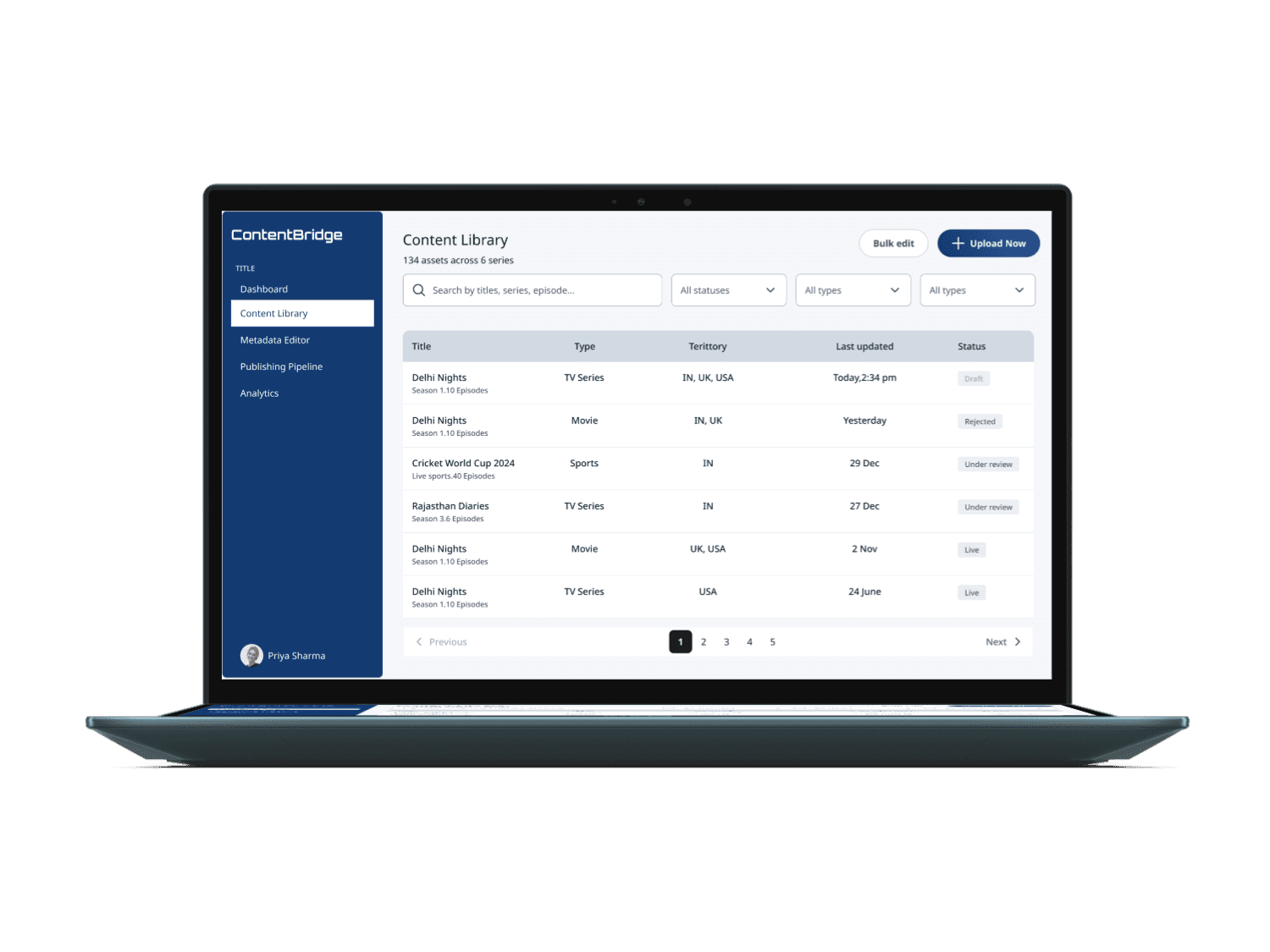
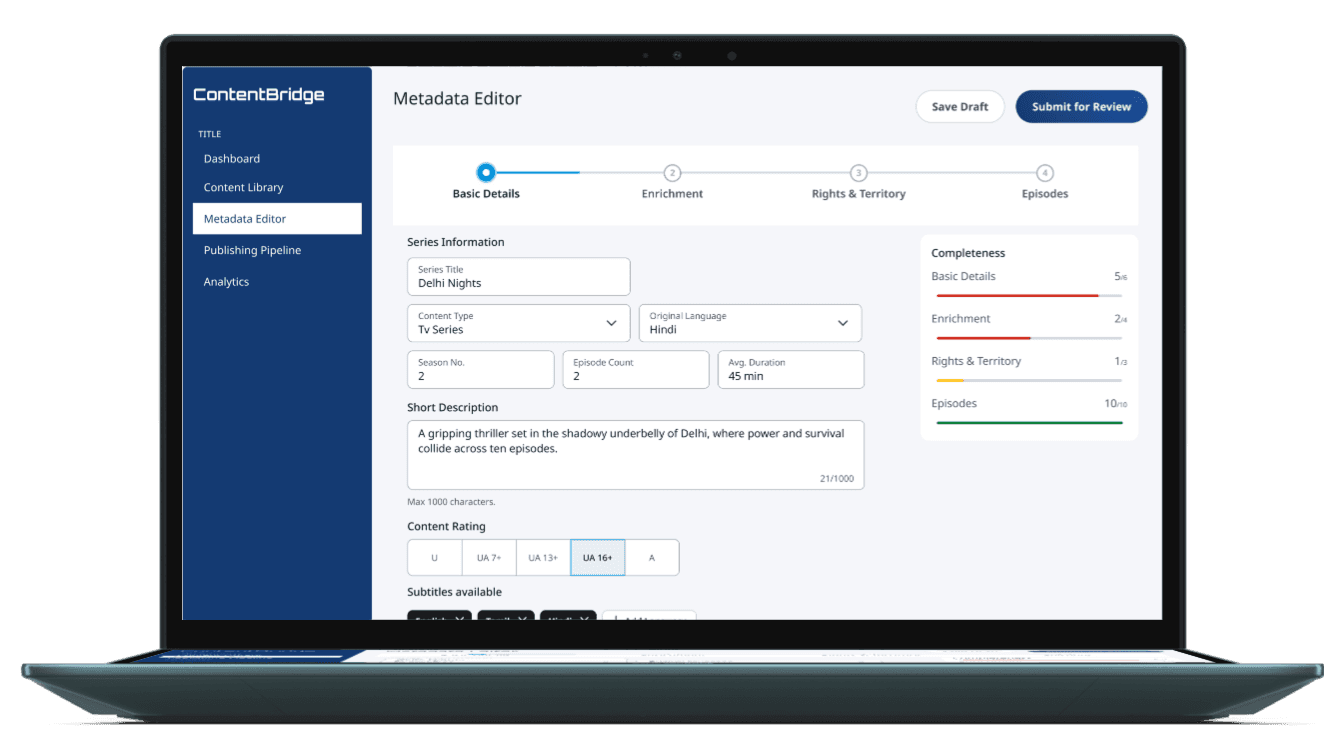
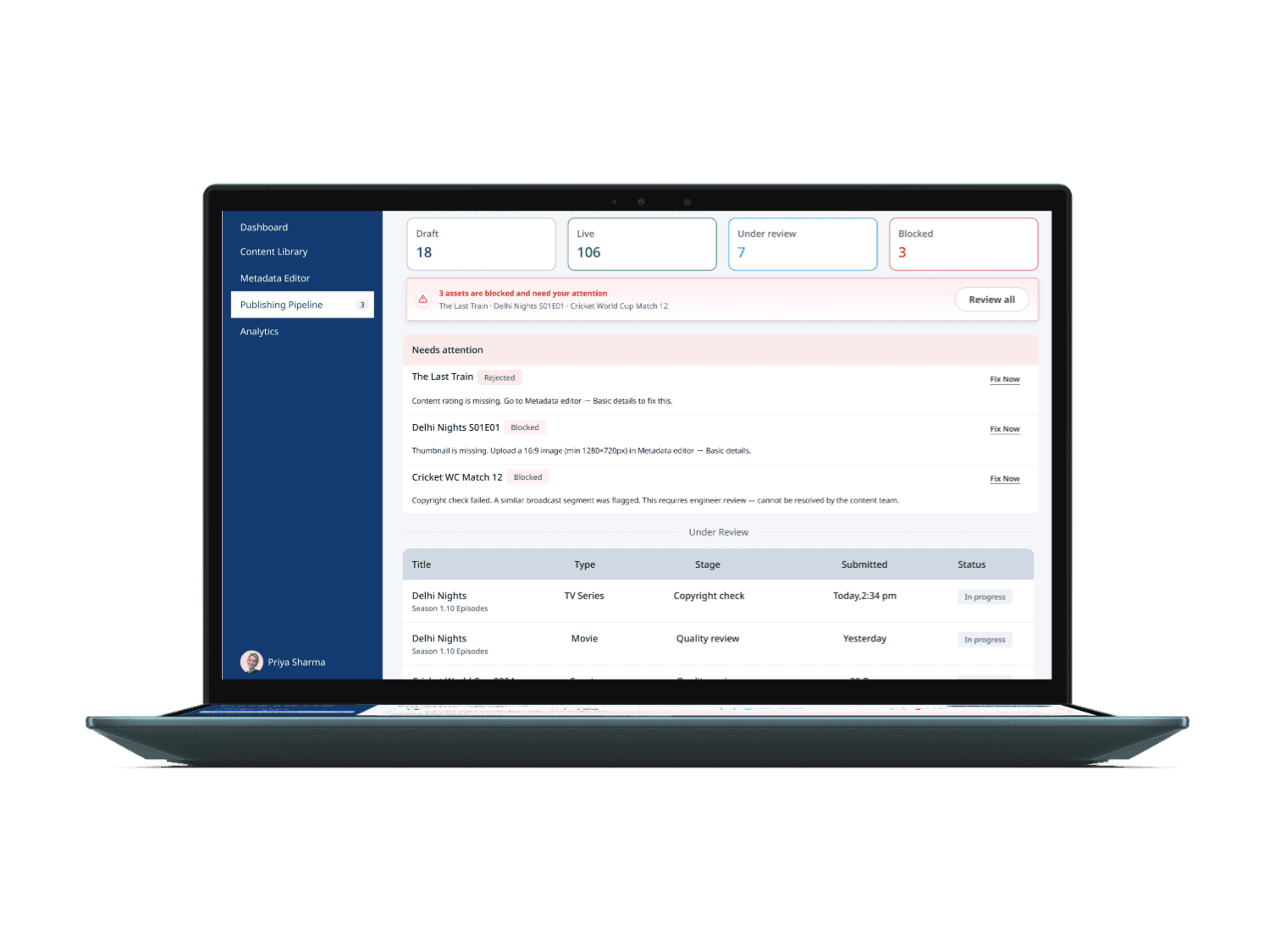
I designed three core screens — each corresponding to one of the three primary user flows, and each addressing a distinct cluster of research findings.
I designed three core screens — each corresponding to one of the three primary user flows, and each addressing a distinct cluster of research findings.
I designed three core screens — each corresponding to one of the three primary user flows, and each addressing a distinct cluster of research findings.
Let's Talk
Feel free to reach out for collaborations or just a friendly hello 😁
© 2026 Naveeta Goswami. Made with 💛 and too many coffee breaks.
Let's Talk
Feel free to reach out for collaborations or just a friendly hello 😁
© 2026 Naveeta Goswami. Made with 💛 and too many coffee breaks.
Let's Talk
Feel free to reach out for collaborations or just a friendly hello 😁
© 2026 Naveeta Goswami. Made with 💛 and too many coffee breaks.